Chelsea FC
A lesson in iniquity?
Chelsea FC, the Kinetic Network, and the Slow Unravelling of a Club
The State of Play
Let's start with the basics. Chelsea Football Club, once the most feared, best-run, most envied club in English football, is a mess. Not a quiet, behind-the-scenes sort of mess — the kind you can brush under the carpet with a few carefully worded press releases. A proper, undeniable, everyone-can-see-it mess. Six managers in four years. Record-breaking financial losses. A squad so bloated it requires a spreadsheet to track. And yet — after all that spending — a first team that has lurched from one crisis to the next, while the people supposedly in charge have remained curiously, stubbornly in post.
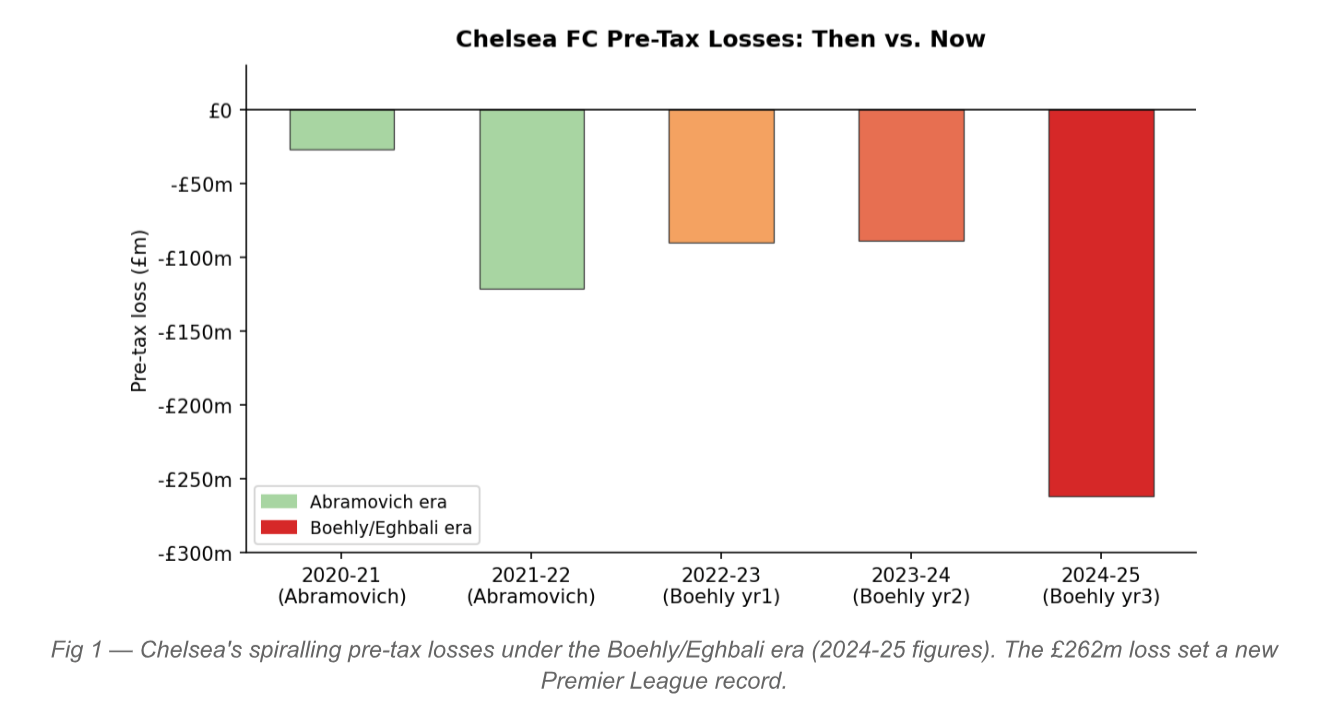
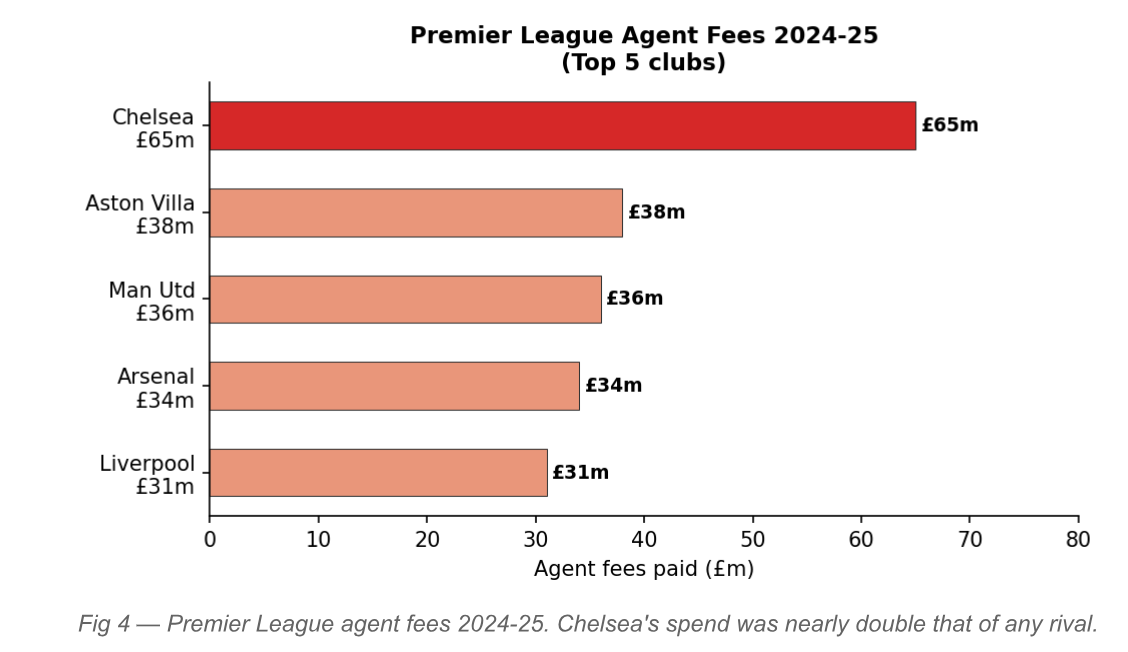
Since American businessman Todd Boehly and Clearlake Capital completed their £4.25 billion takeover in May 2022, Chelsea have spent in excess of £1.5 billion on player transfers. That is not a typo. One-point-five billion pounds. For context, that is more than most clubs spend in a decade. What has it delivered? A pre-tax loss of £262 million in the 2024-25 season alone — a Premier League record, by some distance. Agent fees of £65 million in a single year, almost double the next-highest club. A squad packed with young, expensive, largely underperforming players on contracts so long they'd still be paying some of them out when the next World Cup comes around.
Amid this financial wreckage, a specific set of allegations has taken hold — not in the mainstream press, where lawyers and PR teams keep things carefully vague, but in the sprawling, sometimes hysterical world of fan forums, X (Twitter) threads, and YouTube deep- dives. The central claim: that key appointments at Chelsea — in the dugout, at the training ground, and in the transfer suite — have been made not on merit, but on the basis of personal connections. And that at the heart of those connections sits a modest south London charity called the Kinetic Foundation.
"There is no public evidence of criminal corruption, formal charges, or regulatory findings as of April 2026. What there is — and this is the point — is an extraordinary concentration of appointments that all trace back to the same small network, happening at precisely the moment Chelsea were in freefall."
The Managerial Carousel
Before we get to the detail of the appointments, it is worth pausing on the managerial carnage alone — because it tells you almost everything you need to know about how this club is being run.
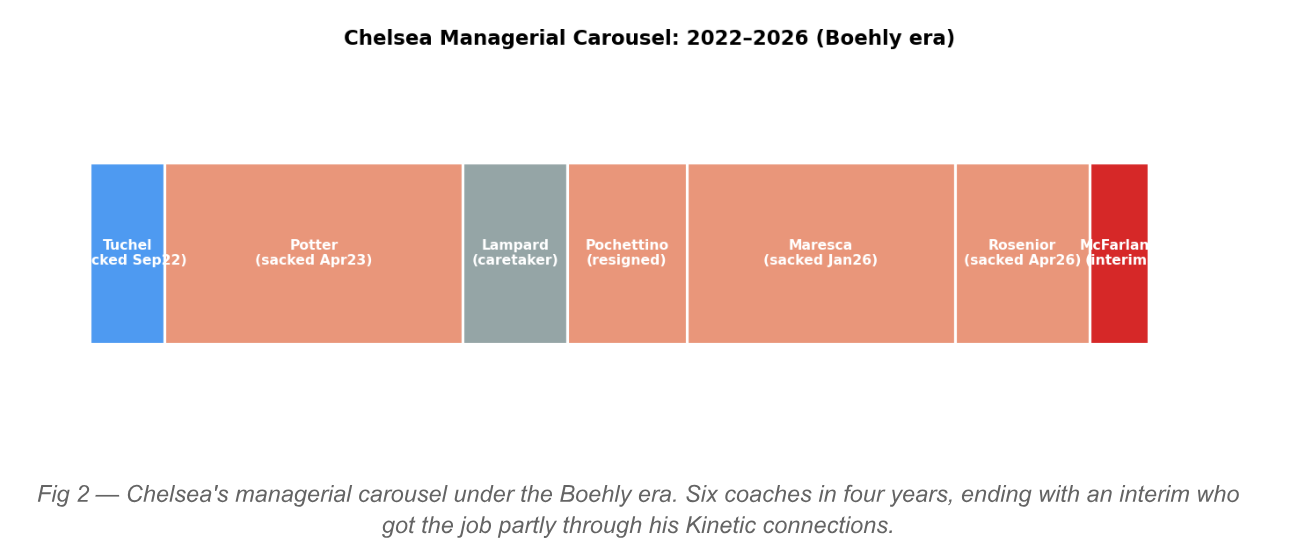
Thomas Tuchel — Champions League winner, a serious, experienced coach — was sacked barely 100 days into the new ownership. Graham Potter followed, and was gone within seven months despite being given a ludicrous six-year contract on arrival. Frank Lampard came back as a caretaker, exited promptly. Mauricio Pochettino lasted a season and then resigned. Enzo Maresca was hired, performed adequately, and was then sacked in January 2026 in circumstances that still haven't been properly explained to fans. Liam Rosenior followed — a likeable, energetic young manager with a point to prove — and was out of the door within months.
Which brings us to the man who has ended up in charge, twice, during this particular season: Calum McFarlane. A coach whose previous peak role, before Chelsea came calling, was running youth teams at Southampton. And before that? He spent six years as academy manager at the Kinetic Foundation — a charity set up to help disadvantaged young people in south London. A worthy cause, no question. But perhaps not the most obvious qualification for managing a Premier League first team.
Who is Joe Shields — and Why Does He Keep Coming Up?
Joe Shields is Chelsea's Co-Director of Recruitment and Talent, appointed in October 2022. He is part of a wider sporting leadership structure that also includes Co-Sporting Directors Laurence Stewart and Paul Winstanley. On paper, it's a sensible, modern set-up. In practice, Shields has become the focal point of some very uncomfortable questions.
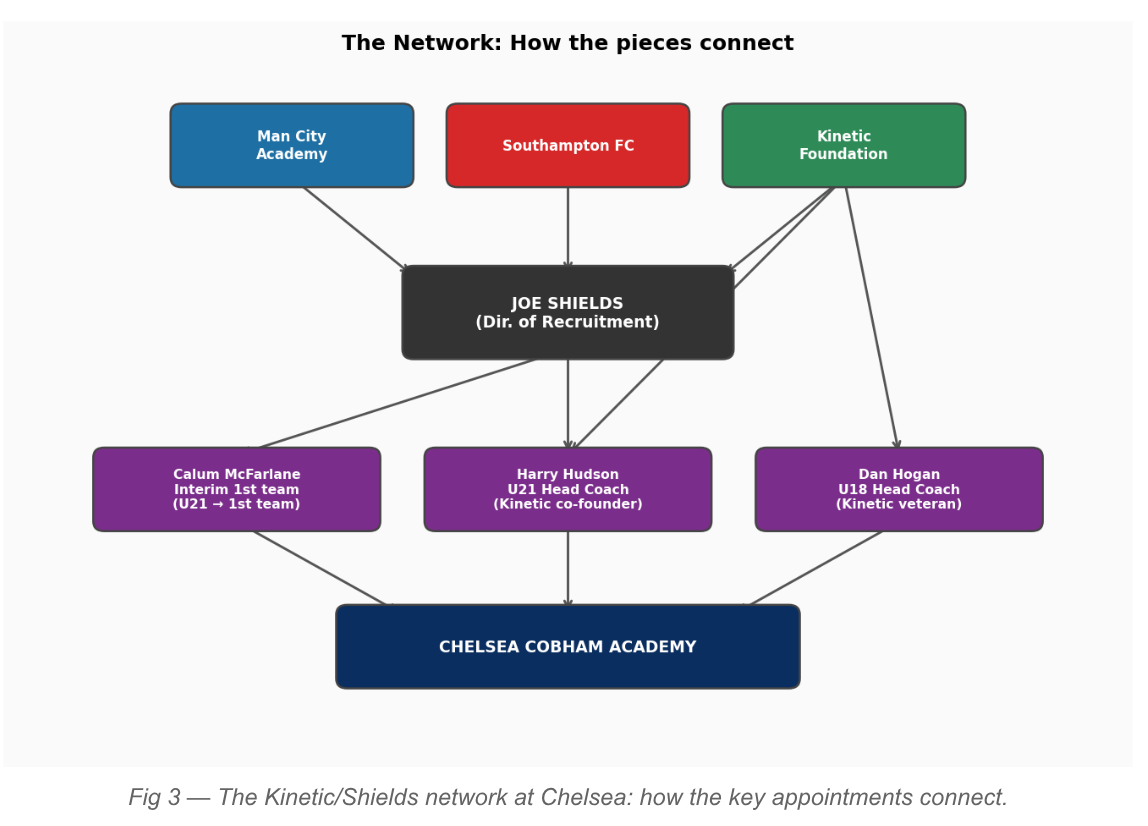
Before Chelsea, Shields worked at Manchester City's academy for nearly a decade — one of the most admired talent pipelines in world football. He then moved to Southampton as Head of Recruitment, where he had a strong reputation for identifying and signing young talent. He is, by most accounts, a genuinely intelligent football man. But in the world of south London grassroots football, he had also built up a network — one that included agents, coaches, and community organisations. Among those organisations: the Kinetic Foundation.
Shields reportedly had scouting connections to Kinetic-linked players and agents, including agent Emeka Obasi, who represented Kinetic alumnus Joe Aribo (signed for Southampton under Shields). Fan investigators on X and Reddit have also flagged alleged links to Elite Project Group (EPG), an agency that represents players including Jamie Bynoe-Gittens, Jadon Sancho, and Romeo Lavia — all either signed by Chelsea or heavily linked. Whether those connections translate into anything improper is unproven. But what is documented, clearly and unambiguously, is what happened next.
The Kinetic Network: A Charity Takes Over Cobham
The Kinetic Foundation is, by all accounts, a genuine and admirable organisation. Founded in 2011 by Harry Hudson and James Fotheringham in the aftermath of the England riots, it uses football and education to support disadvantaged young people in south London aged 11 to 19. It has produced real players — Joe Aribo, Kwadwo Baah, Josh Maja — and its coaches have gone on to work in professional football. It is emphatically not a front, a shell, or anything sinister. This matters, because the most hysterical online commentary sometimes treats it as though it were.
But here is what nobody disputes: in the space of roughly eighteen months between January 2025 and April 2026, three coaches with direct Kinetic connections arrived at Chelsea and rose, with unusual speed, into some of the most significant coaching roles at the club. Here is how it happened.
Calum McFarlane
McFarlane, from Forest Hill in south London, is around 38-40 years old. He spent six years (2014-2020) as academy manager at Kinetic, then moved to Manchester City's academy, then Southampton. He joined Chelsea in summer 2025 as Under-21s head coach. By January 2026 — barely six months later — he was interim first-team manager, following Maresca's sacking. He took charge for a 1-1 draw against Manchester City, a 2-1 defeat to Fulham, and then handed over to the incoming Rosenior as first-team staff. After Rosenior's own sacking, he was interim again. He holds a UEFA A Licence — one step below the Pro Licence required for a permanent top-flight manager. UEFA rules allow temporary appointments without a Pro Licence for up to approximately twelve weeks. Chelsea appear to have used that provision more than once.
Harry Hudson
Hudson is one of Kinetic's co-founders. His coaching career included roles at Brentford's youth setup and, immediately before Chelsea, as Under-18s head coach at Wycombe Wanderers — a League One club. He was appointed Chelsea's Under-18s assistant coach ahead of the 2025-26 season. In January 2026, following McFarlane's promotion to the first team, Hudson was elevated to Under-21s head coach. That is a move from Wycombe's Under-18s to Chelsea's Under-21s in the space of months — bypassing, according to reports, long-serving Chelsea academy coach Hasan Sulaiman, who had been at the club for eighteen-plus years.
Dan Hogan
Hogan's case is the one that most exercises the critics. He joined Chelsea's academy in January 2025, with his club biography noting 'extensive experience' at Kinetic Academy 'over a number of years.' By early 2026 he was Under-16s head coach. By January 2026 he was Under-18s head coach. By April 2026 he had been added to McFarlane's interim first-team backroom staff alongside Hudson. That is a journey from new academy signing to first-team backroom staff within fifteen months. His CV prior to Chelsea is, as far as can be publicly established, rooted almost entirely in Kinetic. His formal coaching licence level has not been publicly stated by Chelsea or confirmed by any credible source.
What is documented: Kinetic itself, in a public post when McFarlane took interim charge, confirmed that he was 'assisted by Harry Hudson and Dan Hogan' — both from the same network. Chelsea's first team was, in that moment, in the hands of three coaches all of whom trace back to a south London charity. Make of that what you will.
Meanwhile, what happened to the people who had built Cobham into arguably the finest academy in England? Neil Bath — the man behind Mount, James, Abraham, Hudson-Odoi — departed in the 2024 restructure. Jim Fraser followed. Hasan Sulaiman, eighteen-plus years at the club, apparently found himself bypassed for the U21 job. The institutional memory of one of the best academies in the world was quietly dismantled, and the pieces replaced with people from the same small circle.
The Transfer Disaster: How to Spend £1.5 Billion and End Up Worse Off
If the coaching appointments are where the nepotism story lives, the transfer strategy is where the incompetence story lives. And the numbers, when you lay them out, are genuinely staggering.
Under Boehly and Eghbali, Chelsea adopted what they called a 'portfolio model' of recruitment: buy many young players cheaply, give them long contracts (up to eight years) to spread the amortisation cost over multiple years and satisfy financial fair play rules, and hope that enough of them come good to justify the total outlay. On paper, it has a certain logic. In practice, it produced a squad of forty-odd players, many of whom couldn't get a game, a wage bill that ballooned out of control, and the worst financial results in the club's history.
Enzo Fernández cost £107 million. Moisés Caicedo cost £115 million-plus. Mykhailo Mudryk cost around £88 million and is currently sidelined following a failed drugs test, an investment that looks increasingly like a write-off. Raheem Sterling, signed on a long and ruinous deal, was released. The agent fees alone — £65.1 million in the 2024-25 season — were almost double those of any other Premier League club. Aston Villa, in second place, paid £38.4 million.
The cumulative post-takeover losses, by April 2026, had exceeded £1.6 billion across the BlueCo group — roughly £10.4 million per week since acquisition. The 2024-25 pre-tax loss of £262.4 million was a Premier League record, beating Manchester City's previous high of £197.5 million from 2011. Chelsea's revenue of £490.9 million was the second-highest in club history. The losses, in other words, are not down to a lack of income. They are down to catastrophic, unchecked spending.
The same recruitment team — Shields, Stewart, Winstanley — has presided over this throughout. Boehly, who briefly served as his own sporting director, has publicly acknowledged mistakes and said the club is pivoting toward more 'ready-made' experienced players. The pivot, fans would note, has been very slow in coming.
The fan theory that the high agent fees represent something more sinister — kickbacks, inflated fees to connected intermediaries, money flowing back to those who approved the deals — remains entirely unproven. It is the kind of speculation that fills a vacuum when a club refuses to explain its decisions. Whether it is true is another matter entirely.
In Fairness: The Case for the Defence
It would be dishonest — and it would make this a much less useful document — to present only one side. So let's be clear about what the evidence actually supports, and what it does not. And let's look honestly at the counter-arguments, because some of them carry genuine weight.
The youth teams are winning
This is perhaps the most awkward fact for the critics to deal with. Under Harry Hudson, Chelsea's Under-21s finished top of the Premier League 2 league phase in 2025-26. Under Dan Hogan, Chelsea's Under-18s were top of the Under-18 Premier League South in April 2026. If these are people who were appointed because of who they know rather than what they can do, someone forgot to tell the players — because both age-group sides have been performing genuinely well.
There is a version of events where McFarlane, Hudson, and Hogan are exactly what their defenders claim: unconventional coaches, from non-traditional backgrounds, who turned out to be rather good at their jobs. Chelsea's academy has, in the past, produced some of the best players in English football. If this cohort of coaches is continuing that tradition — albeit through a different pathway — then the critics may look foolish in a few years' time.
Every fan thinks their club is bent
It is also worth stepping back and acknowledging something uncomfortable: football fans, across the game, are addicted to corruption narratives. When their club overpays for a player, the internet fills with theories about agents taking cuts and directors lining their pockets. When an unexpected appointment is made, it must be because someone knew someone. When things go wrong — as they inevitably do at every club — the explanation can never be plain bad luck or honest misjudgement; it must be something darker.
Some of what circulates about Chelsea on X and Reddit is, frankly, unhinged. The more extreme versions of the 'Kinetic pyramid scheme' theory leap from 'these coaches all know each other' to 'therefore money is being laundered' without any evidence whatsoever in between. Transfer fees that look high to fans often look rational to the clubs, agents, and intermediaries who actually understand the market. Long contracts and youth-focused recruitment — the core of Chelsea's strategy — is not obviously corrupt just because it hasn't produced a title yet.
Hiring people you trust is not nepotism
There is also a legitimate argument that Shields and Chelsea's sporting directors were doing what every sensible football executive does: hiring people they had seen up close, whose work they knew, whose values they trusted. Every manager in football appoints his own backroom staff; every director builds a network and draws on it. The overlap between the Kinetic coaches and Shields' prior career is real, but it does not, in itself, constitute misconduct. Chelsea's own profiles of these coaches present them as people with genuine experience and, in some cases, impressive results.
Kinetic's founders, for their part, have pushed back firmly. They point to their coaches' backgrounds, their qualifications, and their record. They describe the social media campaign against them as 'regrettable.' They note — correctly — that producing coaches who go on to work in professional football is exactly what a good community organisation should be doing.
Conclusion: Good Enough is No Longer Good Enough
Here is where we land, honestly and without the comfort of a tidy resolution.
The case against Chelsea's current leadership is not that they are criminals. There is no proof of that, and it would be irresponsible to suggest otherwise. The case is something more mundane, and in some ways more damning: that they have been consistently, stubbornly, expensively bad at their jobs — and that when it comes to decisions about personnel, the same small network keeps appearing, in role after role, at a club that used to be synonymous with institutional excellence.
Is it nepotism? That depends on your definition. It is, at minimum, a very pronounced preference for people from a specific circle. It is, at minimum, a pattern of promotions that would make most independent observers raise an eyebrow. It has coincided with the departure of highly experienced, long-serving staff who built one of the best academies in England. And it has happened while the first team — the one that actually plays in front of 40,000 people every fortnight — has been an embarrassment.
The youth teams are doing well. Acknowledged. But you do not run a football club so that the Under-21s can top their league while the first team sacks its manager every few months and posts record losses. The first team is the product. The first team is what matters to the supporters who hand over their money, week after week, and watch their club perform well below the standard its wage bill demands.
What is needed, and what has been conspicuously absent, is transparency. Not a Twitter thread. Not a fan forum dossier. Actual, meaningful communication from the club about why these appointments were made, what qualifications were considered, and how they fit into a coherent long-term plan. Chelsea supporters deserve to know whether the people running their football club are making decisions based on merit, or based on familiarity. At the moment, all they can do is look at the results — financial and footballing — and draw their own conclusions.
Those conclusions are not flattering. And the argument that all clubs do this, that all fans complain, that it will all come good in the end — none of it feels adequate when you are sitting in a ground watching a club haemorrhage money, burn through managers, and hand its coaching roles to people whose primary qualification appears to be that they know the right person.
The Boehly/Eghbali project is not yet beyond saving. The Club World Cup offers a financial lifeline. A handful of signings have been impressive. The academies, credit where it is due, are producing results. But four years in, with £1.5 billion spent and little to show for it, the burden of proof has shifted. It is no longer enough to say 'trust the process.' The process has to start working. And the people who have been running it — above all the sporting directors whose fingerprints are on every appointment and every transfer — need to either demonstrate, urgently and openly, that they are the right people for the job. Or they need to be replaced by someone who is.
Chelsea fans have been patient. They have, for the most part, given the new ownership time to find their feet. That patience is running out. And in football, when patience runs out, the calls for change tend to get very loud, very fast.
Parvis Brown 2026